

How I’m Growing Closer to God Through Gratitude, Prayer, and Fasting
For the past three years, I have been writing down 30 things I’m grateful for. Not five or ten, but thirty. Some days, the list comes easily. I can immediately think of my children, my health, my home, the opportunities I’ve received, and the people I love. Other days, I find myself staring at the page thinking, Okay, God…I already said my kids, my home, my health, and my coffee. What else do I have? 😂
But I keep writing.
The interesting thing about my gratitude practice is that not everything on my list has actually happened yet. Yes, you read that correctly. Sometimes, I thank God for things I haven’t received.
For me, gratitude has become more than acknowledging what is physically in front of me. It has become part of my faith. I am learning to thank God for where I am while also trusting Him with where I believe He is leading me.
I Started Thanking God Before I Had the Answer
There are things I have written on my gratitude and goals lists that were not my reality at the time. I wrote them anyway, and I thanked God anyway. Not because I believe God is a magical vending machine where I write down a request, say a prayer, and wait for my order to arrive. My relationship with God is deeper than that.
For me, it is about trust. It is about being able to say, God, I don’t know how this is going to happen. I don’t know when it is going to happen. Your plan may look completely different from mine, but I trust You enough to keep walking.
Trust has not always been easy for me. I have spent so much of my life learning how to figure things out on my own. I make a plan, a backup plan, and probably a backup plan for the backup plan. 😂 As a single mom, it is very easy to feel as though everything rests on your shoulders. The bills, the kids, the decisions, and the future can all feel like your responsibility alone.
Faith, however, has been challenging me to loosen my grip.
And whew, God is still working on me with that one.
My 30 Things Gratitude Practice
My gratitude practice is actually very simple. I sit down and write 30 things I am grateful for. Some of those things are big, such as my children, my health, the roof over my head, and the opportunities God has placed in my life. Others are incredibly small. I might write down a good cup of coffee, a conversation that made me laugh, having enough energy to get through a long day, or even a rare moment of silence.
Then there are the things I’m still praying about. I include some of those too.
I write with gratitude because I am trying to train myself to look for God’s presence before I start looking for everything that is wrong. If I’m being transparent, my brain is extremely good at identifying problems. Like, gold medal level good. 😂 Gratitude forces me to slow down long enough to acknowledge what God has already done instead of constantly focusing on what I believe still needs to happen.
In 1 Thessalonians 5:18, we are told to “give thanks in all circumstances.” That scripture has taken on a different meaning for me as I have grown in my faith. It does not say to give thanks only when everything makes sense or when the prayer has been answered exactly how we wanted.
In all circumstances.
I am still learning what that looks like in my own life.
Using Hallow to Become More Intentional About Prayer
Another tool that has become part of my faith journey is using the #1 prayer app, Hallow. I want to be clear that I don’t believe an app can replace a relationship with God. It can’t. However, I also recognize we live in a world where our phones constantly compete for our attention.
Between Instagram, TikTok, emails, text messages, and notifications, there is always something demanding my attention. Somehow, I can find 30 minutes to scroll but convince myself I don’t have ten minutes to pray.
Please tell me I’m not the only one.
Using Hallow has helped me become more intentional about creating space for prayer. Hallow offers Christian and Catholic prayer content, including guided prayers and Rosary content, which has been helpful when I need more structure in my prayer life.
Sometimes, I don’t know what to say. Other times, my mind is moving in 37 different directions, and I need something to help me refocus my attention on God. Using a guided prayer does not make my faith less genuine. For me, it is simply a tool that helps me become more intentional.
I think sometimes we underestimate the importance of creating an environment where we can become quiet enough to listen.
I’m Learning to Pray the Rosary More Intentionally
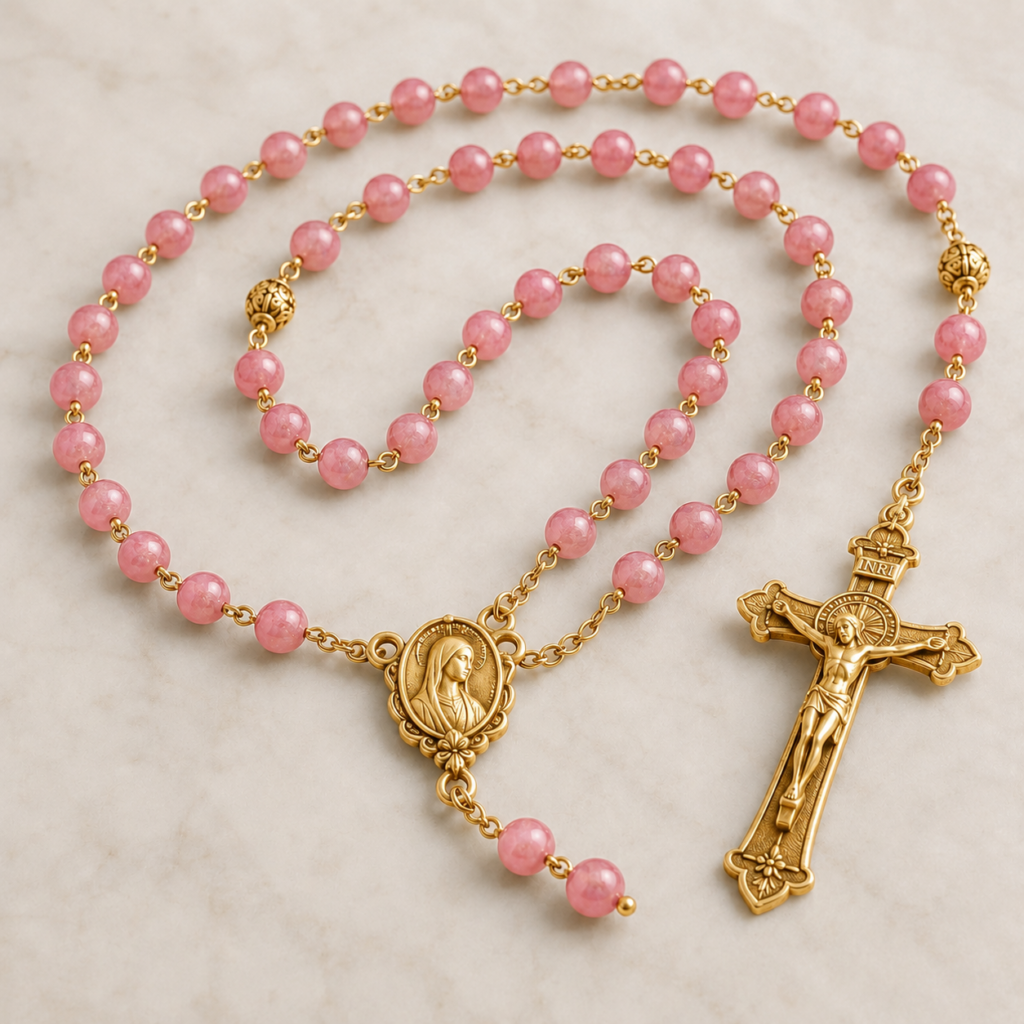
I have also started using my Rosary more intentionally as I work to deepen my relationship with God. This is something I am still growing into, so I will never pretend I have mastered it. There are times when my mind wanders, moments when I have to bring my attention back, and yes, times when I have to remind myself where I was in the prayer.
Still, there is something powerful about slowing down, holding the Rosary in my hands, repeating the prayers, and reflecting on the mysteries. In a life where I am constantly moving, accomplishing, planning, and thinking about what comes next, the Rosary forces me to become still.
I have also developed a deeper appreciation for our Blessed Mother Mary and the way her life continually points us toward Jesus. Her obedience, trust, and willingness to say yes to God without knowing every detail of what would come next speaks deeply to me.
I am the type of person who would really prefer God to send me the full itinerary. I need dates, times, confirmation numbers, and preferably a PDF attached to the email.
But that is not always how faith works.
Sometimes, God asks us to trust Him with the next step before He reveals the entire staircase. Praying the Rosary has been helping me become quieter and, perhaps more importantly, teaching me to listen.
Fasting Has Become About More Than Weight Loss
Fasting is another practice that has started to change for me. If you knew my full journey, you would know that health and weight loss have been a major part of my life. I have lost a significant amount of weight, so for a long time, fasting was closely connected to discipline, health, and changing my body.
I currently use Zero to track my fasts. I like data. I like tracking things. I like watching a timer and knowing exactly how long I have been doing something. Again, God is working on my control issues. Zero provides fasting and nutrition tracking tools, which is why I initially incorporated it into my routine.
Lately, however, I have been thinking about fasting differently.
What if fasting isn’t only about what I’m trying to lose? What if it is also about creating more room for God?
That question has shifted my perspective. Fasting can create moments where I become more aware of my desires, habits, and need for instant gratification. Instead of immediately responding to every feeling of discomfort, I am learning to pause. I can use that moment as a reminder to pray, talk to God, and ask myself what I am actually hungry for.
Because sometimes, it isn’t food.
Sometimes, I am hungry for peace, reassurance, control, or comfort. Sometimes, I need to remember I cannot fill every empty place in my life with something temporary. Fasting is slowly becoming less about controlling my body and more about understanding myself while intentionally turning my attention toward God.
I’m Not Trying to Be a Perfect Christian
I want to make something very clear. I am not writing this blog post because I have figured out faith. I haven’t. I am also not the woman who wakes up every morning at 5 a.m., reads the entire Bible before sunrise, drinks lemon water, and then floats through the rest of her day covered in the peace of the Lord.
Some mornings, I’m tired. Some days, I’m irritated. Sometimes, I question things, worry, and pray about a situation only to try controlling the outcome five minutes later.
I am human.
But I am becoming more intentional about my relationship with God. I am becoming more intentional about gratitude, prayer, the Rosary, and fasting. More than anything, I am trying to recognize God’s presence in my everyday life.
I don’t only want to run to God when my life is falling apart.
I want to know Him when life is good too.
Learning to Trust God Outside of Survival Mode
For a long time, survival was familiar to me. My response to almost everything was to fight, push, work harder, figure it out, and keep going. In many ways, that mentality helped me survive some incredibly difficult seasons of my life.
Now, I find myself asking a different question: What happens when God brings you out of survival mode, but your mind is still living there?
That is something I am actively working through. Even when life becomes safer, your habits and thought patterns do not automatically change. You can still wake up expecting something to go wrong. You can feel guilty when you rest. You can believe if you aren’t constantly working, planning, or preparing, everything will fall apart.
My faith is challenging that part of me. I am learning I can be disciplined without living in fear. I can have goals without worshiping the outcome. I can work hard without believing everything depends solely on me.
And I can be grateful for what I have while still believing there is more ahead.
Maybe Gratitude Is an Act of Faith
Every time I sit down to write my list of 30 things, I am reminding myself God has already been good to me. Before the next goal, the next opportunity, the next answered prayer, or the next version of myself, God has already been good.
So yes, I will continue writing down 30 things I’m grateful for. I will continue praying, learning to pray the Rosary more intentionally, and exploring fasting as part of my spiritual discipline. I will also continue thanking God for some things I haven’t seen yet.
Not because I know exactly what He is going to do, but because I am learning to trust the One who does.
One prayer at a time. One fast at a time. One gratitude list at a time.
Maybe that is how we grow closer to God. Not by becoming perfect overnight, but by choosing, again and again, to make room for Him.
With love,
Brie 🤍
![One Powerful Truth About Faith Without Works [2026]](https://therichmommie.com/wp-content/uploads/2026/06/pexels-gstudio-11070660-768x1075.jpg)